
ORIGIN OF THE HYPERGROWTH CONCEPT

The term “hypergrowth” was introduced in a 2008 Harvard Business Review article, describing the rapid S-curve growth phase in emerging markets where winners are quickly separated from losers—often before it’s even apparent. The World Economic Forum later standardized a definition of hypergrowth as a 40%+ year-over-year compound annual growth rate in revenue – essentially quantifying the steepness of the aforementioned S-curve. By studying the characteristics and patterns of companies in the stock market that experience this exceptional growth in revenue, Golden Eagle Strategies was able to pioneer in Hypergrowth Investing.
APPLYING HYPERGROWTH TO STOCKS
Golden Eagle Strategies built on top of the work of the Harvard Business Review and World Economic Forum by explicitly studying the characteristics and patterns of hypergrowth companies across the stock market in order to identify “Hypergrowth Stocks”. Hypergrowth Stocks are defined thus as: the stock of a company that shows a year over year sales growth rate of greater than 40% in the latest reported quarter. It’s nearly impossible to predict when hypergrowth will occur or how long it will last. Evaluating growth on an annual basis risks missing it altogether.
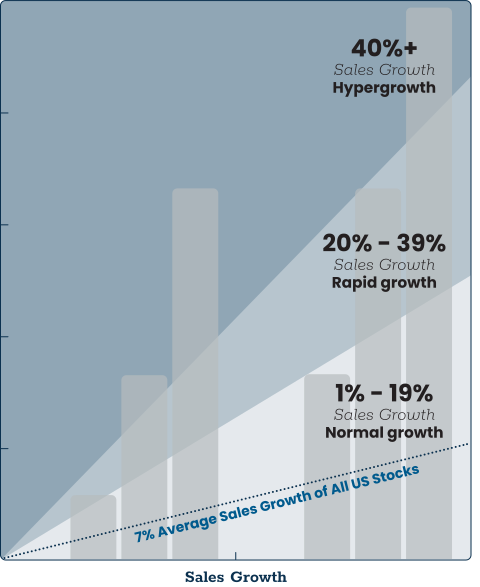
Defining Hypergrowth1
HYPERGROWTH STOCK PROMINENCE
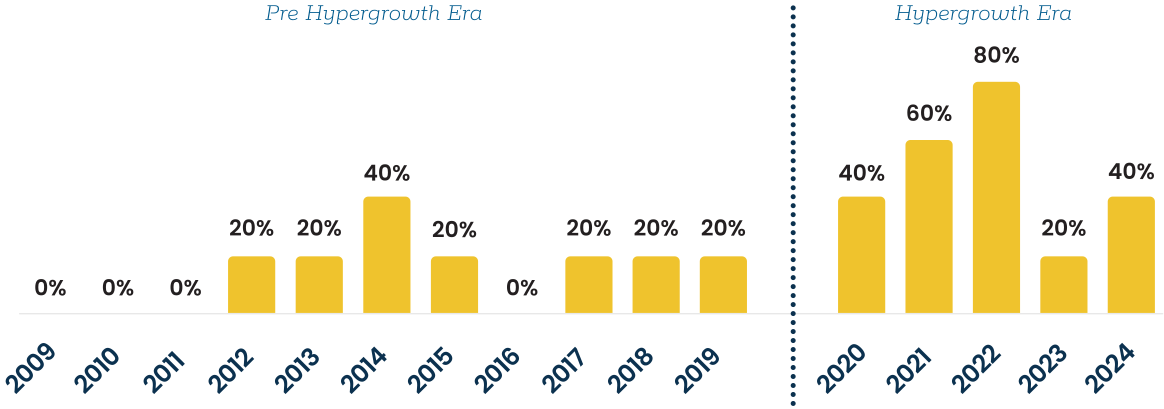
As new technologies are applied across all industries—even traditionally mundane ones like retail, energy, and communications—growth rates are accelerating. The impact is already evident, as shown below: over the past five years, Hypergrowth Stocks have taken a prominent place among the top five performers. This shift marks the rise of a new era of elite growth stocks poised to thrive in the years ahead: Hypergrowth Stocks.
Hypergrowth Stocks Among Top 5 Performing S&P Stocks2
Based on Golden Eagle Strategies Study
ENTERING A NEW ECONOMIC REALITY
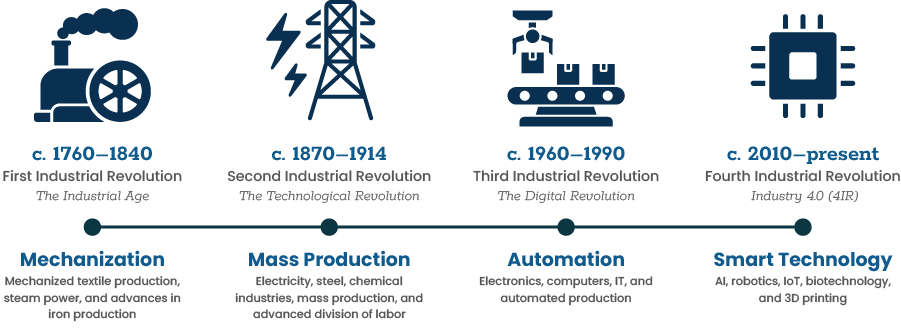
According to the World Economic Forum, the world has entered a ‘Fourth Industrial Revolution’. Amid accelerating change in technology, globalization, and market structure, the pace at which businesses scale and gain market share has fundamentally shifted. The emergence of AI, automation, platform economies, and digital infrastructure has created fertile ground for a new class of companies that grow at extraordinary speeds—hypergrowth companies. New technologies are being applied across all industries. The speed of current breakthroughs has no historical precedent. Companies are able to scale up faster than ever before and achieve hypergrowth sales growth rates of 40% or higher.
Stages of the Industrial Revolution3
With the emergence of artificial intelligence and other technological advancements, Hypergrowth Stocks should flourish on the world landscape in the years ahead.
What is Hypergrowth Investing?
Hypergrowth Investing is a strategy focused on building a diversified group of companies that have demonstrated year over year sales growth of at least 40% – with the goal of achieving higher long-term returns. To invest in Hypergrowth Stocks, it is important understand how to identify these stocks early in order to benefit from the upward price momentum that typically occurs during periods of hypergrowth. Identifying Hypergrowth Stocks can mean uncovering the potential market leaders of tomorrow.
- Yahoo data and the research of Golden Eagle.
In 2016, the World Economic Forum conducted a study breaking companies into three different classes of growth (normal growth, rapid growth, and hypergrowth). Golden Eagle Strategies applied this framework to Hypergrowth Stocks by dividing stocks into similar categories of growth for research purposes using the sales growth metric. We define ‘normal growth’ as companies generating sales growth up to 20%, ‘rapid growth’ as companies generating sales growth greater than 20% but less than 40%, and ‘hypergrowth’ as companies generating sales growth rates of 40% or more year over year.The graphic illustrates how Golden Eagle applied the World Economic Forum (WEF) categorization of growth rates. The WEF categorized companies into three different levels of growth. Similar to the World Economic Forum, Golden Eagle divided growth stocks into three different categories: normal growth (1-19% sales growth), rapid growth (20-39% sales growth) and hypergrowth (40%+ sales growth). The average sales growth of all U.S. Stocks is 7%.← - Yahoo data and the research of Golden Eagle. Examples of specific investments are included herein to illustrate the investment process and analyses that the Adviser intends to utilize going forward and were selected for inclusion based on objective, non-performance-based criteria. Examples are not intended to indicate overall portfolio performance that may be expected to be achieved by the Fund. Opinions expressed herein are subject to change without notice.
The graphic illustrates that from 2009 to 2019, during the Pre-Hypergrowth Era as defined by Golden Eagle, Hypergrowth Stocks – which are sometimes referred to as “Hypergrowers” – typically accounted for 0-20% of the top 5 S&P 500 stocks based on annual performance. The momentum shifted significantly during the hypergrowth era starting in 2020, when the share of Hypergrowth Stocks started to become increasingly dominant. From 2020 to 2025, Hypergrowth Stocks have averaged over 40% of the top 5 S&P 500 stocks. in 2023, this cohort accounted for 80% of the market’s top-performing stocks.← - This infographic illustrates the evolution of global industry across four transformative eras. It begins with the First Industrial Revolution (c. 1760–1840), which was marked by a transition to machine production powered by steam and water power. This was followed by the Second Industrial Revolution (c. 1870–1914), a period of mass production driven by electricity, steel and petroleum. The Third Industrial Revolution (c. 1960–1990) sparked the Digital Revolution, utilized electronics, computers and information technology to achieve automation. Finally, the Fourth Industrial Revolution (c. 2010–Present), or Industry 4.0, represents the current age of smart technology, where AI, robotics, and the Internet of Things (IoT) create highly interconnected and intelligent systems←