
March, 2026 | Download PDF

FOCUSED ON AN ELITE SEGMENT OF GROWTH STOCKS
2026 Hypergrowth Stock Trend Report
The March 2026 Hypergrowth Stock Trend Report traces back to 1978, when our Founder and CIO took over the Axe Houghton Stock Fund which had been underperforming. He introduced quantitative research and discovered a simple but powerful truth: price follows earnings. Nearly 50 years of research have continually reinforced this finding—faster growth drives higher returns.
Our philosophy is simple, to maximize returns, we target the fastest growing companies in the world. This approach led to the launch of the alternative investment Golden Eagle Hypergrowth Fund in 2020 and the Golden Eagle Dynamic Hypergrowth ETF in 2025. Today, growth opportunities are greater than ever due to globalization, technology, AI, and automation—fueling a new class of hypergrowth companies. Our research shows that traditional metrics like P/E ratios, favored by most investors, have little correlation with top-performing stocks. Instead, exceptional winners are defined by strong sales growth, exceeding 40% year over year.
In this report, we explain what Hypergrowth Stocks are, where to find them, and why their return potential is so compelling.
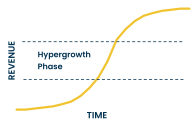
The Hypergrowth Curve1
WHAT IS HYPERGROWTH?
The concept of hypergrowth was introduced in a 2008 Harvard Business Review article2, describing the rapid S-curve growth phase in emerging markets where a few companies rapidly separate from competitors—often before the market fully recognizes them.
Later, the World Economic Forum formalized the definition: 40%+ year-over-year compound annual revenue growth, quantifying what that steep S-curve looks like in measurable terms.3
Learn more about the history of hypergrowth at InvestingInHypergrowth.com.
How does Hypergrowth apply to the stock market?
Golden Eagle Strategies applied this growth framework directly to the U.S. equity market by adopting the 40%+ revenue growth standard as an objective definition of a “Hypergrowth Stock.” We then augmented our systematic, rules-based methodology to measure it across daily, monthly, quarterly, and annual intervals — reflecting the dynamic nature of public markets.
Our research, spanning a quarter million stock performance periods over 16+ years4:
- Establishes a precise, repeatable definition;
- Measures hypergrowth consistently across the full market;
- Tracks how it propagates across sectors and cycles.
In essence, we converted an academic growth concept into a disciplined, data-driven framework for identifying and studying hypergrowth within the stock market.
Hypergrowth Stocks
A stock that shows a year over year sales growth rate of greater than 40% in the latest reported quarter.
Why Should Investors Care About Hypergrowth Stocks?
Finding #1: Hypergrowth Is Always Occurring Across the Economy
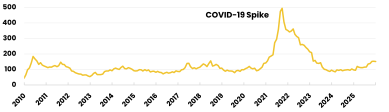
Number of Hypergrowth Stocks Per Month (2010-2025)5
129
Average Number of Hypergrowth Stocks Per Month5
Hypergrowth persists even in bear markets and recessions, and is not confined to one sector. Companies can scale rapidly through innovation, capital shifts, supply-demand imbalances, pricing power, or macro forces. Market disruptions—commodity spikes, policy shifts, geopolitical events, and changing investor preferences—continually create new opportunities. From 2010–2025, an average of 129 stocks per month achieved hypergrowth, though totals fluctuated.5 During COVID-19, demand surges and abundant capital fueled explosive gains in e-commerce, cloud, digital entertainment, and healthcare.
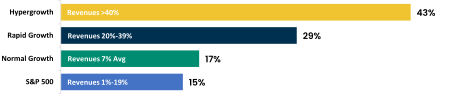
Finding #2: Hypergrowth Stocks Can Produce Powerful Returns
Annualized Return (2009-2025)6
Finding #3: Hypergrowth is Differentiated Growth
2%
Average Percentage of Hypergrowth Stocks in S&P 5007
5%
Average Percentage of Hypergrowth Stocks in Nasdaq 1008
Hypergrowth companies are often underrepresented in major indices and traditional funds according to our research on Hypergrowth Stocks between 2010 and 2025. Most indices are constructed using market-cap weighting, where companies typically become meaningful constituents only after they have already scaled and matured. As a result, much of the hypergrowth phase of growth can occur before they represent a significant weight in passive portfolios. Therefore, to capture this segment investors may require a strategy designed to identify companies earlier in their growth trajectory.
What are Current Hypergrowth Trends?
We analyzed the Hypergrowth Stock universe over the full year of 2025 (12/31/24–12/31/25). In the following analyses, you can see how companies achieving hypergrowth status shift dynamically across sectors, industries, market cap, and geographies.
SECTOR ANALYSIS
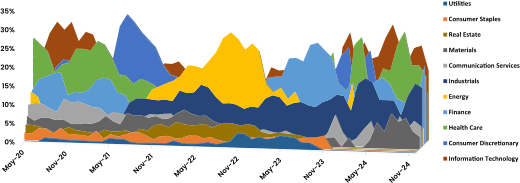
Entering 2025, Hypergrowth was concentrated in Finance, Healthcare, and Information Technology. While these sectors remained strong at the end of the year, Materials saw a notable increase, almost doubling in concentration while Industrials, Consumer Discretionary, and Communication Services declined.
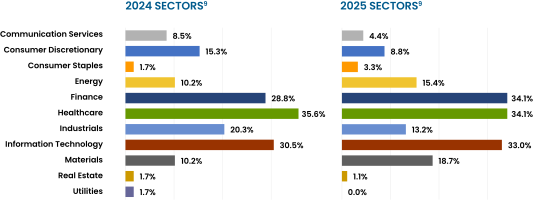
Importantly, because hypergrowth is a dynamic phase of company growth that can occur quickly, it can move in waves as illustrated in the month-by-month chart below. As such, it is our view that you need a broad-based, systematic process to capture the right Hypergrowth Stocks at the right time.
Hypergrowth Stocks ROTATE Across Sectors (May 2020 – December 2024)10
INDUSTRY HIGHLIGHTS11
Looking below sector-level trends provides a clearer view of how hypergrowth is shifting across the economy. In 2025, several key patterns emerged:
- “Hard Asset” Surge – Metals & Mining
Precious metals have emerged as a major driver. The Metals & Mining sector was virtually irrelevant with 1 hypergrowth company at the start of 2024 but surged to 16 by the end of 2025, fueled by strong gold and silver price appreciation. - Energy & Oil/Gas Expansion
Hypergrowth companies in Energy/Oil & Gas increased from 4 to 12 over this period. Notably, the AI boom is creating additional demand as data centers drive energy consumption. - AI Infrastructure in Software
The Software sector saw hypergrowth companies spike from 5 to 16 with the focus shifting from general SaaS solutions to AI-specific applications and data center infrastructure, reflecting rapid AI adoption.
These trends illustrate a broader shift in the liquidity tide of growth markets. When the tide is high, supported by abundant liquidity and strong risk appetite, capital flows toward long-duration, innovation-driven sectors reflecting valuations based on future potential. As macro conditions tighten through rising interest rates, inflation, or economic uncertainty, the tide begins to recede, and capital rotates toward asset heavy, shorter-duration industries such as energy and metals. This shift reflects a recalibration of risk tolerance rather than a rejection of innovation, with investors placing greater emphasis on resilience and near-term performance across the economy.
MARKET CAP12
Hypergrowth spans all market caps—from recent IPOs to established companies leveraging reinvestment and advanced tools to rapidly expand revenue. In practice, most scalable, investable hypergrowth opportunities are mid- to large-cap firms accelerating sales capacity. New technologies now enable mature companies across industries to achieve 40%+ year-over-year revenue growth, making high growth possible even for companies that are already well-established.
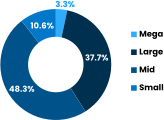
Please see footnote #12 for capitalization ranges
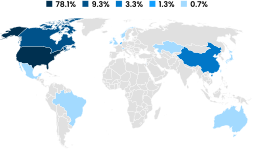
Geography12
including ADRs. In a globalized, technology-enabled world, capital flows efficiently across borders, providing access to non-U.S. companies on U.S. exchanges. About 28% of S&P 500 revenues come from abroad, as domestic firms tap global markets and foreign firms seek U.S. capital.14 Hypergrowth follows similar patterns. In the 2025 year-end snapshot, Canadian mining stocks surged alongside U.S. peers due to industry strength.
What are Examples of Hypergrowth Stocks?
The following case studies look at companies that achieved 40%+ year-over-year revenue growth. It is important to note that these case studies are not forecasts; they examine retrospectively the companies that reached this threshold and explore the conditions that produced exceptional growth rates. Please note, of the examples below, Golden Eagle portfolios has owned Ticker IREN, in the past. As of this report, Ticker CDE is currently owned by Golden Eagle portfolios.
Let’s examine two stocks—one a traditional hypergrowth company (software) and the other a cyclical hypergrowth company (mining). Traditional hypergrowth is driven by technological innovation and rapid adoption, often amplified by abundant liquidity supporting long-duration growth stories such as SaaS or biotech. Cyclical hypergrowth, by contrast, tends to emerge from macro forces like commodity cycles, supply constraints, or shifts in economic activity.
IREN Ltd (NASDAQ: IREN): AI Power Pivot15
IREN, formerly Iris Energy, is a next-generation data center operator. Originally built around vertically integrated bitcoin mining, the company pivoted in 2024–2025 toward AI infrastructure, repositioning itself as an AI cloud services provider. This strategic shift drove a significant re-rating in the stock as investors recognized its role in the emerging AI infrastructure buildout.
Factors that propelled IREN to Hypergrowth status:
- AI Cloud Expansion: In 2024, IREN expanded beyond bitcoin mining by launching its AI Cloud Services segment, positioning the company to capture rapidly growing demand for AI infrastructure.
- Major Infrastructure Agreement: A $9.7 billion agreement to provide AI cloud infrastructure significantly accelerated IREN’s shift as a credible AI infrastructure provider.
- Energy Infrastructure Advantage: The company repurposed existing mining sites into AI data centers, leveraging its access to large-scale renewable power to support AI workloads.
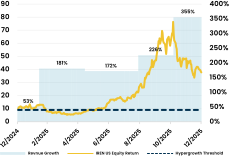
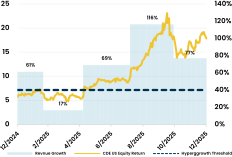
Coeur Mining, Inc. (NYSE: CDE): Operational & Cyclical Hypergrowth16
Coeur Mining, Inc. (NYSE: CDE) is a precious metals producer with gold and silver operations across North America. After several years of investment and expansion, the company entered a period of hypergrowth in 2025 following a major operational ramp alongside a strong bull market in gold and silver.
Factors that propelled CDE to Hypergrowth status:
- Rochester Mine Expansion: The company’s flagship mine completed a major expansion in 2024 and ramped to full capacity in 2025, driving a sharp increase in silver and gold production.
- SilverCrest Acquisition: The 2025 acquisition of SilverCrest Metals added the high-grade Las Chispas mine in Mexico, contributing significant production and cash flow.
- Precious Metals Bull Market: A historic surge in gold and silver prices amplified the impact of rising production, driving a sharp increase in earnings.
Does Hypergrowth Always Occur, Even in Bear Markets?
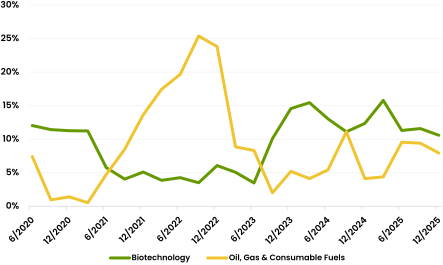
Hypergrowth stocks are inherently dynamic, moving fluidly across sectors as economic conditions change. Opportunity in the market never disappears—it simply shifts. In any economic environment, including recessions, some companies benefit from the very forces that challenge others. Because every ‘negative’ influence creates a ‘positive’ outcome somewhere else in the economy, there are always businesses emerging with powerful growth.
Hypergrowth representation within industries (May 2020 – December 2025)17
Biotechnology (Healthcare)
Biotech is a classic example of traditional hypergrowth. Companies often undergo long development cycles before hitting explosive revenue growth from successful products. When blockbusters launch, sales can remain elevated for years, making biotech a consistent contributor to hypergrowth opportunities. However, post-COVID, the sector experienced a structural slowdown: rapid expansion in 2020–2021, combined with higher interest rates, curtailed R&D investment and reduced the number of hypergrowth stocks in this space. Our research shows that during such periods, outperformance shifts to other sectors where businesses continue to grow rapidly.
Oil & Gas (Energy)
Energy illustrates cyclical hypergrowth. Post-pandemic shocks in supply and demand created a sudden, short-lived surge for oil companies. While 2022 was challenging for growth stocks broadly (the iShares Russell 1000 Growth ETF returned –29.3% vs. –7.7% for the Russell 1000 Value ETF, Bloomberg), the S&P 500 Energy Sector rose 65.5%, offering a clear, time-sensitive opportunity for nimble investors to capture gains.18
What Are the Key Takeaways?
This Hypergrowth Trend Report reflects our commitment to studying—and helping investors better understand—one of the market’s most dynamic segments.
- Hypergrowth occurs across the entire economy: It is not confined to technology. Companies can scale rapidly across sectors when innovation, shifting demand, or macro forces create the right conditions.
- Hypergrowth opportunities rotate across sectors: The Hypergrowth Stock Universe extends beyond traditional “hot” sectors like AI, software, and biotech to include cyclical opportunities in areas such as energy and materials, allowing investors to access growth across multiple parts of the economy.
- Hypergrowth is structurally underrepresented in major indices: Because most benchmarks are market-cap weighted, companies often enter indices only after they have already scaled—meaning much of the most explosive growth occurs before they become meaningful benchmark constituents.
Beyond the data, we are passionate about educating investors and engaging with anyone interested in Hypergrowth Investing—because we believe investors should have access to this elite segment of growth stocks.
Visit our Websites: Click to LEARN MORE ABOUT HYPERGROWTH STOCKS


About Golden Eagle Strategies
Golden Eagle Strategies, LLC is a boutique investment advisory firm that specializes in growth equities. We regard ourselves as stock scientists, always scratching beneath the surface, mining data and running studies in seeking to identify the common threads of top performing stocks in pursuit of superior performance. Today, we focus on Hypergrowth Stocks – a dynamic and powerful asset class that emerged in 2008 and has since outperformed every major equity category, based upon our research. We manage two strategies to help investors gain targeted exposure to Hypergrowth Stocks: a privately managed alternative investment fund and an ETF (HYP).
Author Biographies

Robert Zuccaro, CFA
Founder & Chief Investment Officer
Robert Zuccaro is the Founder & CIO of Golden Eagle Strategies. Over the course of his 40+ year investment management career, Robert has managed market leading institutional portfolios and two mutual funds. He is one of the most successful investment managers having been named a top 10 manager in numerous years by the Wall Street Journal, Business Week, and Investor’s Business Daily. He’s also been cited for outstanding performance by leading publications including Financial World, New York Times, and USA Today.
Robert began his career at E.W. Axe & Co managing the flagship Axe-Houghton Stock Fund, which outperformed the S&P 500 for six straight years under his management. As an early pioneer in applying statistical analysis to portfolio management, Robert’s research has focused on identifying the common statistical threads of top performing stocks. Golden Eagle Strategies represents the culmination of four decades of research and expertise honed over the course of 10 bull and 9 bear markets. His research has revealed unconventional truths that drive the performance of the Golden Eagle Growth Strategy.
As a prolific researcher, life-long educator and philanthropist, Robert has authored numerous studies, market commentaries, and the book, “How Wall Street Reshaped America’s Destiny”. He holds an MBA from Pace University.

Marc Zuccaro, CFA
Managing Principal, Portfolio Manager
Marc Zuccaro is Managing Principal and Co-Founder of Golden Eagle Strategies where he serves as the Portfolio Manager for the Golden Eagle Dynamic Hypergrowth ETF and Co-Portfolio Manager of the firm’s Alternative Investment Fund, the Golden Eagle Hypergrowth Strategy. In addition, Marc oversees the firm’s strategic direction, organizational structure and trading operations.
Marc is the architect of Golden Eagle’s proprietary systematic stock screening process, which conducts a daily analysis of the full universe of U.S.-listed equities. This process is designed to identify companies exhibiting exceptional business acceleration and scalable growth potential. He also leads the development and oversight of the firm’s stock performance research platform, which supports Golden Eagle’s rigorous, data-driven approach to portfolio construction.
Prior to co-founding Golden Eagle, Marc built and managed electronic trading businesses in global equity markets at leading investment banks. He was a Managing Director at RBC Capital Markets in London, where he led the firm’s electronic trading platform across EMEA during a period of strategic expansion. Earlier in his career, he held senior product and management roles within the equities divisions of Lehman Brothers in London, Tokyo, and New York, and began his career at PaineWebber/UBS. Marc holds a Bachelor of Science in Economics and Political Science from Bates College.
This information is for illustration and discussion purposes only. Golden Eagle makes no assertion about any particular comparable firm providing or any employee’s previous employment / academic experience guaranteeing any particular knowledge, skill or service level. References made to awards/rankings are not an endorsement by any third party to invest with Golden Eagle and are not indicative of future performance. Investors should not rely on awards/rankings for any purpose and should conduct their own review prior to investing.
Appendix
Methodology
The Hypergrowth Trend Report applies a rules-based, data-driven framework to identify and study a defined universe of hypergrowth companies across the U.S. equity market. The purpose of this methodology is not security selection or portfolio construction, but rather to establish a transparent and replicable definition of “hypergrowth” suitable for longitudinal research and cross-sectional analysis.
Universe Definition – The initial universe consists of all U.S.-listed common equities, including ADRs, across all sectors, industries, and market capitalizations. Closed-end funds, ETFs, SPACs prior to de-SPAC completion, preferred shares, and other non-operating vehicles are excluded to maintain consistency in operating company analysis.
Hypergrowth Qualification Criteria – To qualify for inclusion in the Hypergrowth Stock Universe, companies must meet objective financial thresholds designed to capture sustained and scalable operating expansion.
- Revenue Growth Rate: Minimum trailing twelve-month sales growth rates of ≥40% year-over-year.
- Revenue Scale Floor: Minimum trailing twelve-month revenue threshold of $100M million to exclude micro-scale statistical distortions.
- Liquidity Threshold: Minimum average daily trading volume of $25M and at least 200,000 average daily traded shares over the past 20 trading days to ensure reliable market data.
- Data Integrity: Availability of standardized financial reporting sufficient for comparative analysis.
Qualification Criteria Considerations – The objective thresholds used to define the Hypergrowth Stock Universe ensure consistency and comparability but may introduce certain limitations:
- Growth Threshold: The ≥40% revenue growth requirement focuses on rapid expansion but may exclude companies with strong long-term growth that temporarily fall below this level.
- Revenue Scale: The $100M minimum revenue threshold reduces distortions from very small companies but may exclude earlier-stage firms prior to reaching this scale.
- Liquidity Filters: Minimum trading volume requirements improve data reliability but may limit the universe by excluding smaller or less liquid publicly listed companies.
Data Period Considerations – The analysis is based primarily on data from 2009–2025. Market conditions during this period may differ from other timeframes, and observed trends may not be representative of longer-term historical patterns or future market environments.
Disclosures
Golden Eagle Strategies, LLC (“the Adviser”) is an investment adviser registered with the U.S. Securities and Exchange Commission (“SEC”). Registration with the SEC does not imply a certain level of skill or training.
No Investment Advice / Informational Purposes Only – This report is provided for informational and educational purposes only and does not constitute investment advice, a recommendation, or an offer to buy or sell any security or investment product. The information contained herein does not take into account the specific investment objectives, financial situation, or particular needs of any individual recipient. Recipients should consult their financial advisor before making any investment decisions.
Sources of Information – The information contained in this report has been obtained from sources believed to be reliable; however, the Adviser does not represent or warrant its accuracy, completeness, or reliability. Any data, projections, or estimates are subject to change without notice.
Opinions and Forward-Looking Statements – Any opinions or views expressed are those of the Adviser as of the date of publication and are subject to change without notice. Certain information contained in this report may include forward-looking statements, forecasts, estimates, and projections that reflect the Adviser’s current views. These statements are inherently uncertain, and actual results may differ materially from those expressed or implied.
Investment Risks – All investments involve risk, including the possible loss of principal. Past performance does not guarantee future results. Market conditions may change, which may impact the information contained in this report.
Performance Disclosure – Any performance results presented herein are for illustrative purposes only and may not reflect the actual performance of client portfolios. Past performance is not indicative of future results.
Conflicts of Interest – The Adviser, its affiliates, employees, or clients may hold positions in securities or investments discussed in this report. The Adviser and its clients may buy or sell such securities without further notice. The Adviser may provide advisory services to clients that hold securities mentioned in this report and may receive advisory fees based on assets under management.
Third-Party Data – Certain information contained herein may be based on third-party sources or data providers. Such information is believed to be reliable but has not been independently verified by the Adviser.
Additional Information – Additional information about the Adviser, including its services, fees, and disciplinary history, is available in the Adviser’s Form ADV, which can be obtained from the SEC’s Investment Adviser Public Disclosure website.
Analyst Certification – The views expressed in this report accurately reflect the personal views of the author(s) regarding the securities discussed. The views and opinions expressed herein are those of Golden Eagle Strategies as of the date hereof and are subject to change based on prevailing market and economic conditions.
No Offer of Securities – Nothing contained herein should be construed as an offer to sell or solicitation of an offer to buy any security.
Data details are available upon request by contacting [email protected]
Footnotes
- Chart is a theoretical chart prepared by Golden Eagle Strategies for visual representation only.
- Article from Harvard Business Review article April 2006 https://hbr.org/2008/04/managing-hypergrowth
- The World Economic Forum (WEF) formalized this definition in a report titled “Mastering Hypergrowth,” which was released on April 28, 2016. Understanding Hypergrowth Holds Key to a Global Economy in Transition > Press releases | World Economic Forum and Mastering Hypergrowth – Reports – World Economic Forum
- Based upon Golden Eagle research that has a little over 235,000 stock periods in our database dating back 2009.
- At the end of each month, Golden Eagle reviews a universe of approximately 1,700 U.S. publicly traded stocks and ADRs (number can vary each month), sourced from Bloomberg and identifies those stocks that meets the qualification of a Hypergrowth Stock – this in turn becomes our Hypergrowth Universe. Such criteria include:
- Revenue Growth Rate: Minimum trailing twelve-month sales growth rates of ≥40% year-over-year.
- Revenue Scale Floor: Minimum trailing twelve-month revenue threshold of $100M million to exclude micro-scale statistical distortions.
- Liquidity Threshold: Minimum average daily trading volume of $25M and at least 200,000 average daily traded shares over the past 20 trading days to ensure reliable market data.
- Data Integrity: Availability of standardized financial reporting sufficient for comparative analysis.
Details are available upon request.
- Data is based upon internal research compiled by Golden Eagle and is the latest available data, sourced from Bloomberg.
- Returns are illustrative and not the result of a hypothetical investment model; they show the opportunity associated with investing in different growth ranges.
- Annual returns for each group have been constructed retrospectively to illustrate the price behavior during the fiscal period which corresponds to their sales growth rates.
- The universe of stocks uses comprises the S&P 500, plus the top 1000 Nasdaq stocks by market cap.
- We ignored companies with less than $100 million in revenue during the year of comparison.
- To harmonize data, we only included companies with December fiscal year-ends; this covers approximately 82% of companies. This is being done to prevent performance period mismatches.
- Represents the average of the annual percentages of S&P 500 constituents achieving 40% or greater year-over-year revenue growth for each year from 2009 to 2025. Source: Bloomberg.
- Represents the average of the annual percentages of Nasdaq 100 constituents achieving 40% or greater year-over-year revenue growth for each year from 2009 to 2025. Source: Bloomberg.
- The data is based on data derived as denoted in footnote number 5. The industry sector is based on the Global Industry Classification Standard (GICS) categories and sourced from Bloomberg.
- The data is based on data derived as denoted in footnote number five. The industry sector codes are based on the Global Industry Classification Standard (GICS) categories and sourced from Bloomberg.
- The data is based on data derived as denoted in footnote number 5. The industry designation is based on the Global Industry Classification Standard (GICS) system and sourced from Bloomberg.
- Market Cap is based upon the Golden Eagle Hypergrowth Universe as of December 31, 2025, and data is sourced from Bloomberg. Market Cap ranges used are:
- Micro < $500 million or less
- Small $500 million plus to 2 billion
- Medium $2 billion plus to $10 billion
- Large $10 billion plus to $200 billion
- Mega > $200 billion
- Geographic breakdown is based upon the Golden Eagle Hypergrowth Universe as of December 31, 2025, and data is based upon the location of the corporate headquarters of the companies in the universe, sourced from Bloomberg. See footnote number 5 as to how the list is derived.
- Goldman Sachs Equity Research. Article with data: Goldman analyzes foreign sales exposure of U.S. firms By Investing.com – 7/20/25
- Data for the case was sourced using publicly available financial information, press releases, and Bloomberg.
- Data for the case was sourced using publicly available financial information, press releases, and Bloomberg.
- See footnote 5 for details of the data.
- Data sourced from Bloomberg.